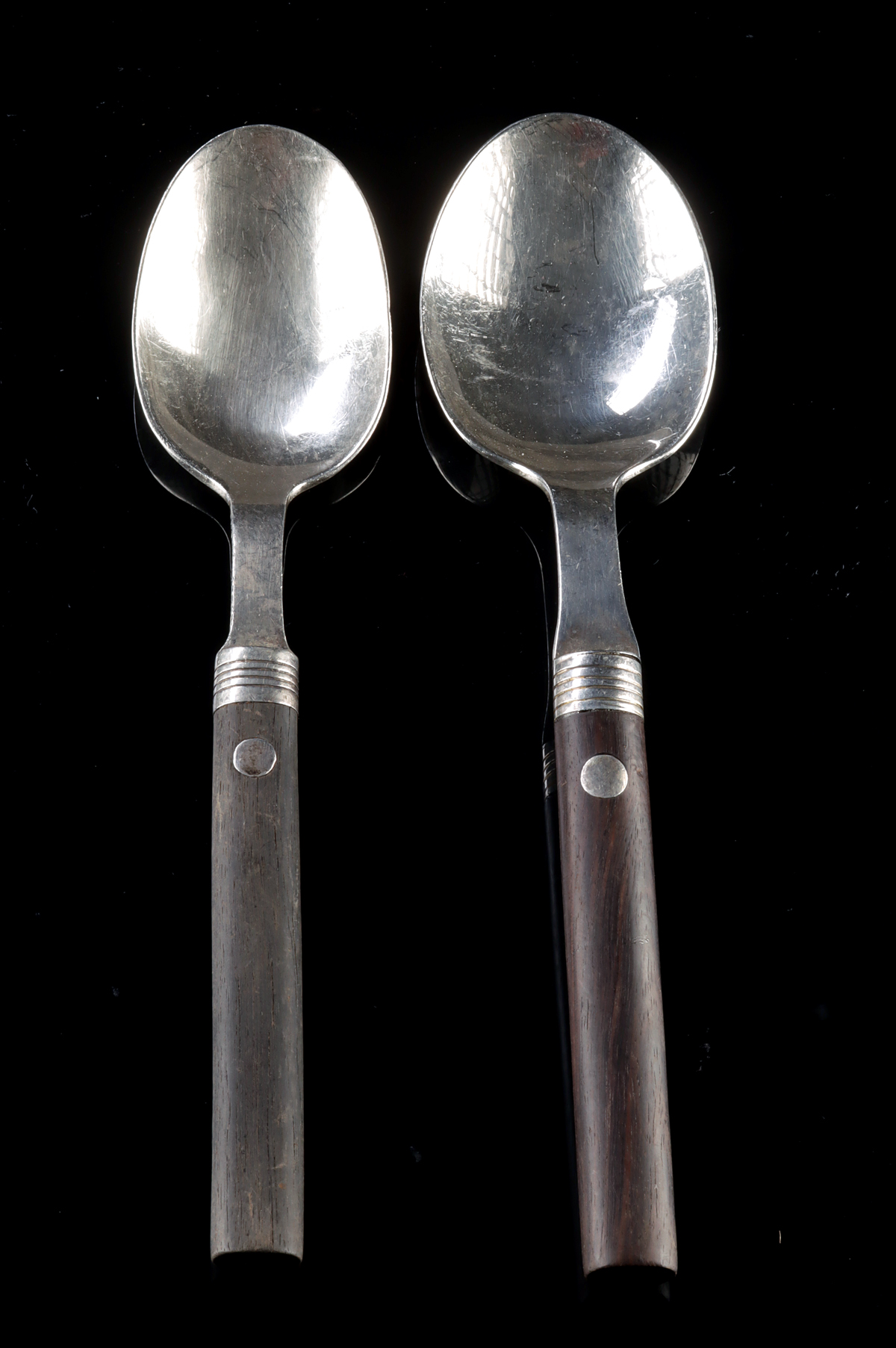
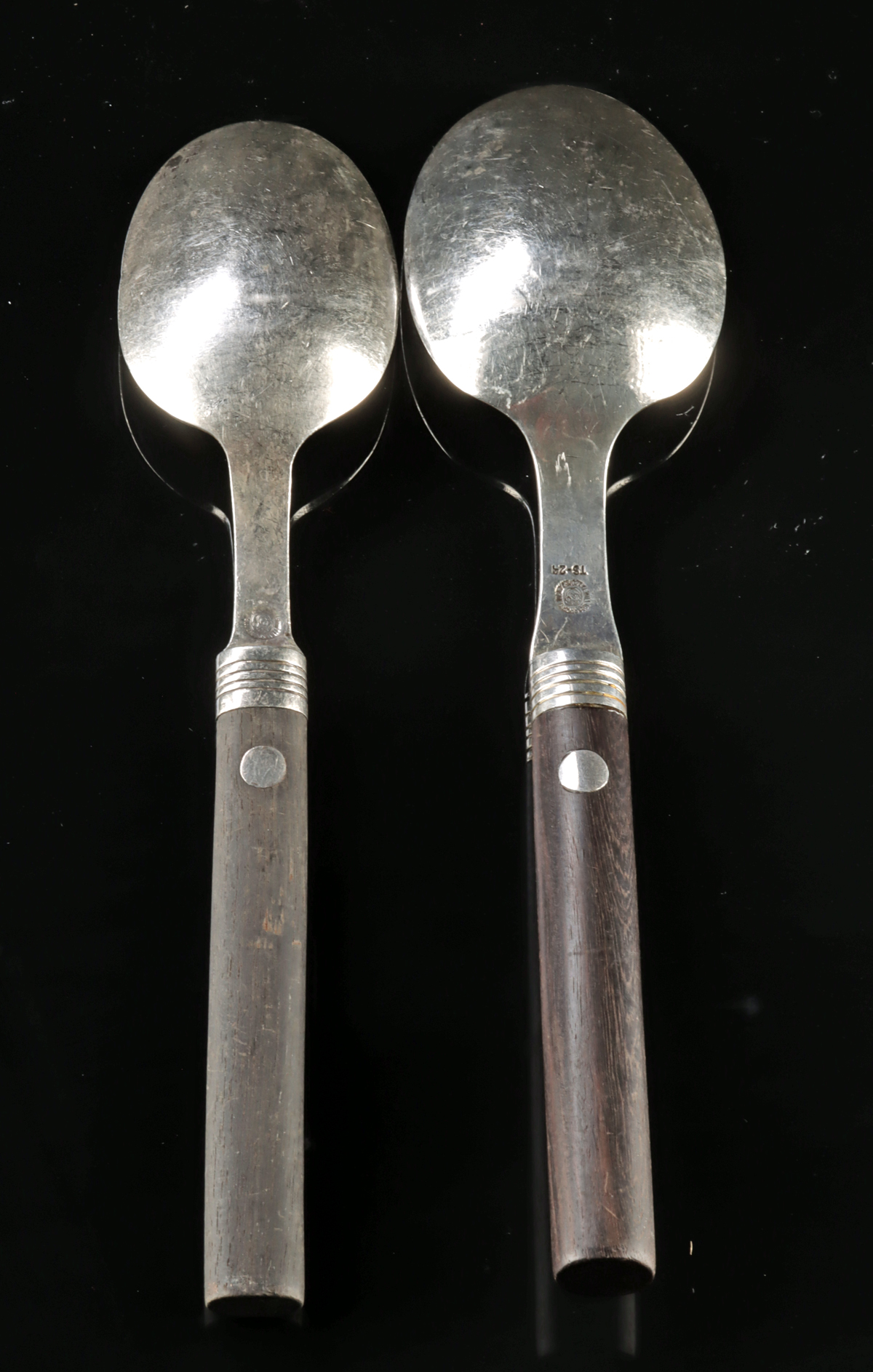
Lot 131, Auction 4/12/2026: 2 Mexican Silver & Wood Spoons – Spratling TS-24
$520.00
In stock
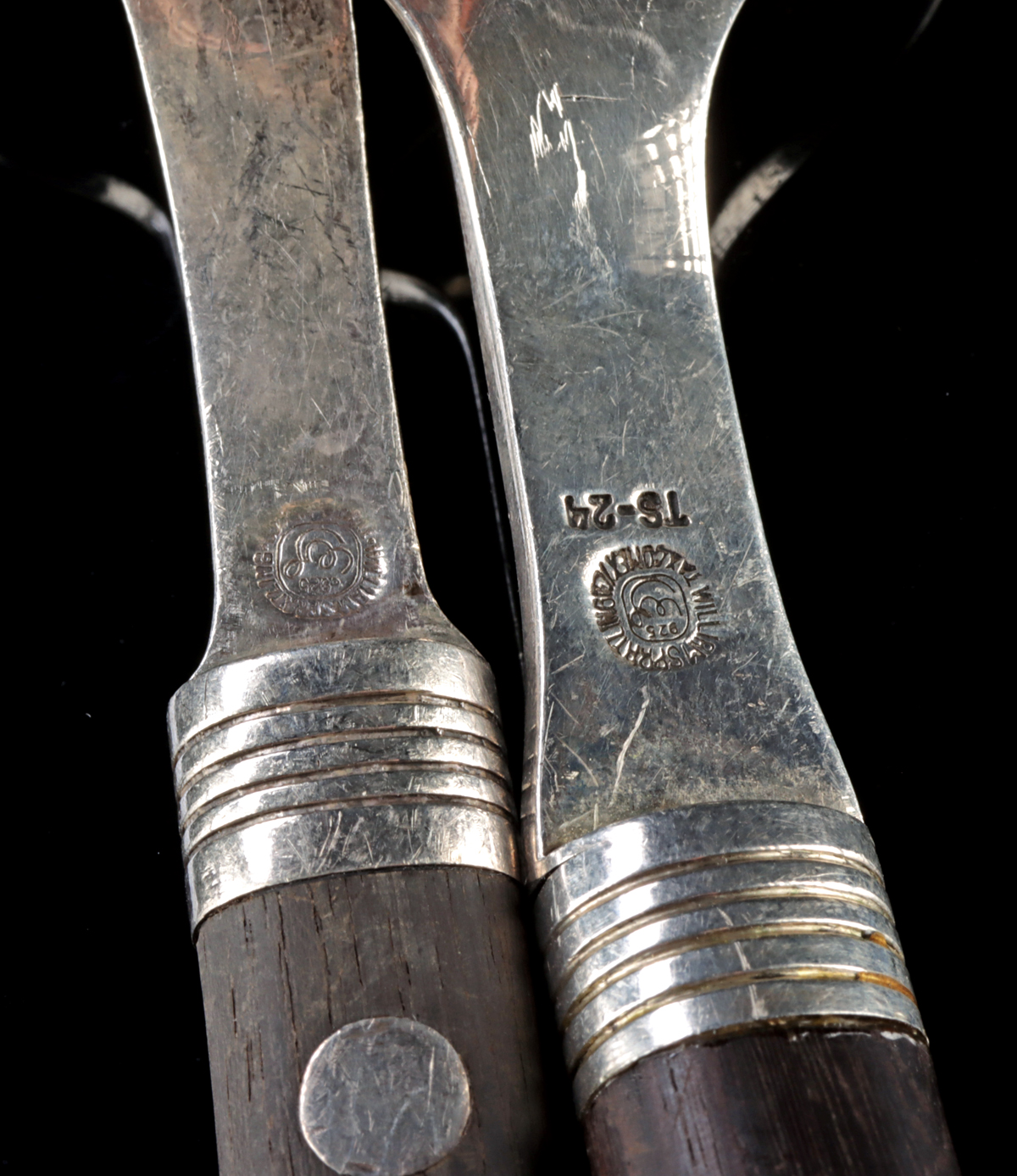
William Spratling (American/expatriate in Mexico, 1900-1967). Produced by Sucesores de William Spratling. Two silver and wood spoons, ca. 1979 or later. Both marked with Spratling hallmark on versos; one marked with “TS-24” silver quality mark on verso. A refined pair of Mexican silver and wood spoons produced by Sucesores de William Spratling, each bearing the Spratling workshop mark and a “TS-24” assay on one indicating post-1979 manufacture, their gently rounded bowls and sleek, tapering handles embodying the clean, modernist aesthetic that defined Taxco silver design. The contrast between the cool luster of the silver and the rich warmth of the wood grips lends both visual balance and tactile appeal, while their craftsmanship reflects the continued legacy of Spratling’s influential workshop and its role in shaping 20th century Mexican silver production. Size of larger (marked “TS-24″): 8.25″ L x 2” W (21 cm x 5.1 cm); silver quality: 92.2% to 93.7%; total weight: 132 grams
William Spratling made his initial visit to Mexico in 1926, and returned each summer for the next several years. Finally, in 1929, Spratling actually moved to Mexico to be an expatriate, becoming an active member of the vibrant artistic circles of Mexico. Spratling promoted the art of none other than Diego Rivera to New York galleries which led to Rivera’s participation in the first exhibition of Mexican visual culture held in the United States, funded by the Carnegie Institute, that opened at the Metropolitan Museum of Art in New York. Not only did Spratling assist in curating the exhibition, but he also lent a number of his own pieces. During this same time period, Spratling was working on drawings for the expanding Morrow (US Ambassador to Mexico Dwight Morrow and his wife, the poet Elizabeth Cutter Morrow) home in Cuernavaca. Many of these drawings were included in the book written by Elizabeth Morrow entitled, “Casa Manana” (Knopf, 1930). It was Ambassador Morrow who suggested that Spratling explore developing the silver industry in Taxco.
_x000D_
_x000D_
Trying to find a way to support himself as an expatriate artist, Spratling took notice of the Taxco’s silver-mining history and opened a workshop called the Taller de las Delicias, which translates to “Factory of Delights”. Years later, he would write: “Nineteen-thirty-one was a notable year in modern Mexican silversmithing. A young silversmith from Iguala named Artemio Navarrete went to Taxco to work for a small silver shop, founded with the germ of an idea, where Artemio, as a nucleus, began to form silversmiths. The present writer, encouraged by his friends Moises Saenz, Dwight Morrow and Diego Rivera, had set up that little shop called ‘Las Delicias.'”
_x000D_
_x000D_
Penny Chittim Morrill, Ph.D., who co-authored “Mexican Silver: 20th Century Hand-wrought Jewelry & Silver” with art dealer Carole Berk is the primary authority on Spratling’s work. Morrill was the guest curator for the 2002 traveling exhibition entitled, “William Spratling and the Mexican Silver Renaissance: Maestros de Plata,” organized by the San Diego Museum of Art. In her catalogue essay, Morrill stated, “In establishing silver as an artistic medium, what Spratling achieved was a delicate balance, a synthesis of abstract tendencies in the existent folk art tradition and in contemporary fine art, resulting in a visualization of concepts and ideas. As importantly, the Taller de las Delicias, became the paradigm for other silver designers to follow. Las Delicias was a community in which imagination and innovation were fostered and encouraged as the men learned the art of silversmithing while producing for profit. In the hierarchy of the workshop, these silversmiths advanced according to their ability, enthusiasm, and technical expertise.”
Condition: Expected surface wear with light scratches to silver and some minor, stable, hairline fissures to wood. Otherwise, intact and very nice. Both marked with Spratling hallmark on versos; one marked with “TS-24” silver quality mark on verso.
Provenance: ex-private Moore collection, Denver, Colorado, USA, acquired prior to 1990
All items legal to buy/sell under U.S. Statute covering cultural patrimony Code 2600, CHAPTER 14, and are guaranteed to be as described or your money back.
A Certificate of Authenticity will accompany all purchases.
We ship worldwide and handle all shipping in-house for your convenience.
Related Products
-


Lot 68b, Auction 4/12/2026: Two Moche High Quality Gold & Silver Tweezers
Add to cart -


Lot 65, Auction 4/12/2026: Costa Rican Miniature Stone Metate – Curved Leg
Add to cart -


Lot 59, Auction 4/12/2026: Ancient Mesoamerican Conical Stone Pestle Mano Tool
Add to cart -


Lot 42, Auction 4/12/2026: Published 19th C. Navajo Silver Spoon & Reference Book
Add to cart -


Lot 40a, Auction 4/12/2026: Two Archaic Native American Full Groove Axe Heads
Add to cart -


Lot 40, Auction 4/12/2026: Native American Archaic to Woodland Stone Metate & Mano
Add to cart -

Lot 39a, Auction 4/12/2026: Six Ancient Native American Spear Points & Chert Tools
Add to cart -

Lot 38a, Auction 4/12/2026: Native American Stone Projectile Points & Lithic Tools
Add to cart -

Lot 37a, Auction 4/12/2026: Native American Arrowheads & Stone Tools Collection
Add to cart -


Lot 37, Auction 4/12/2026: Native American Archaic Stone Tools, Hammerstones & Axe
Add to cart