Lot 17, Auction 3/19/2026: 18th C. Chinese Qing Wood Guanyin w/ Demons
$2,925.00
In stock
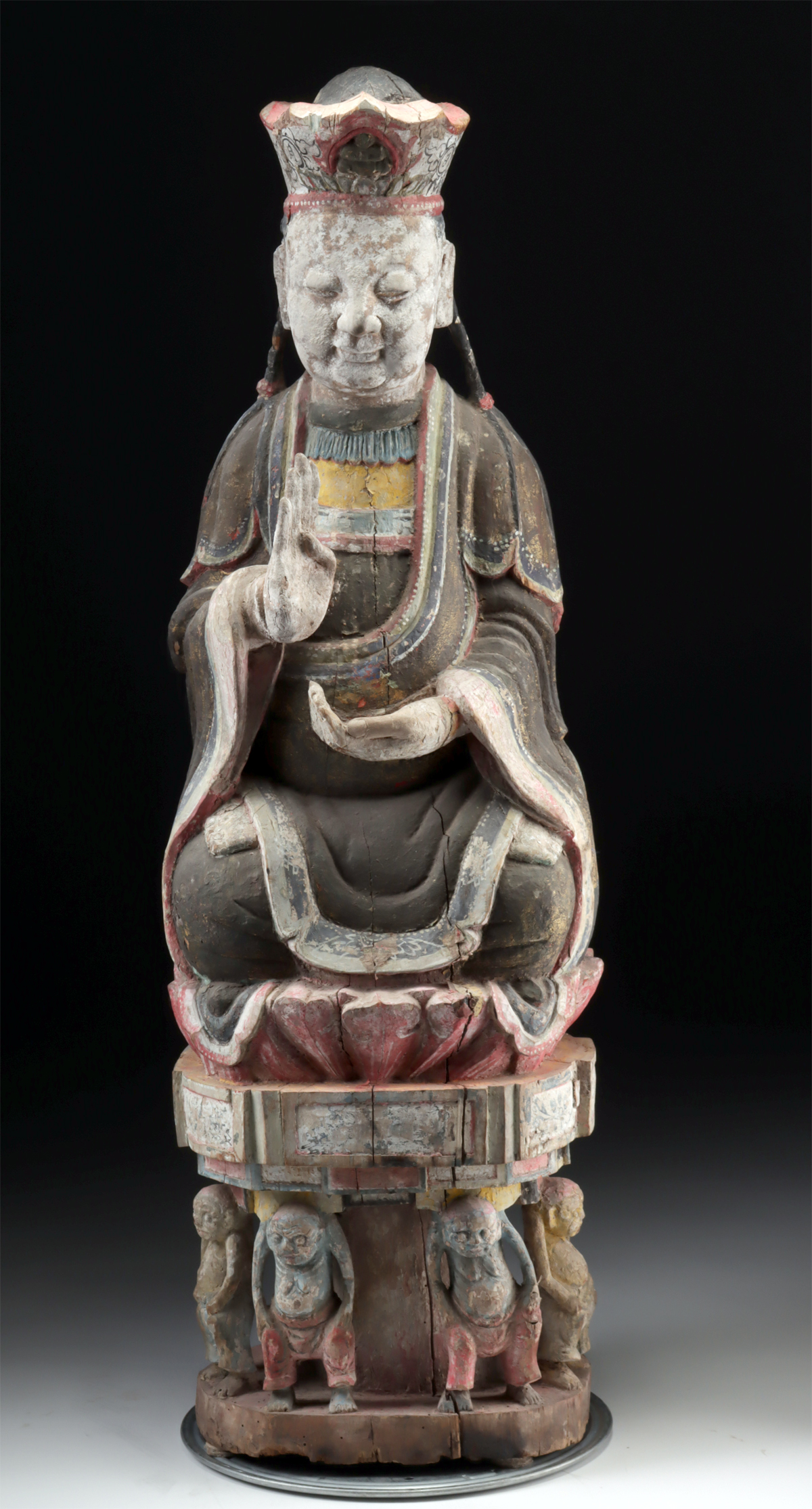
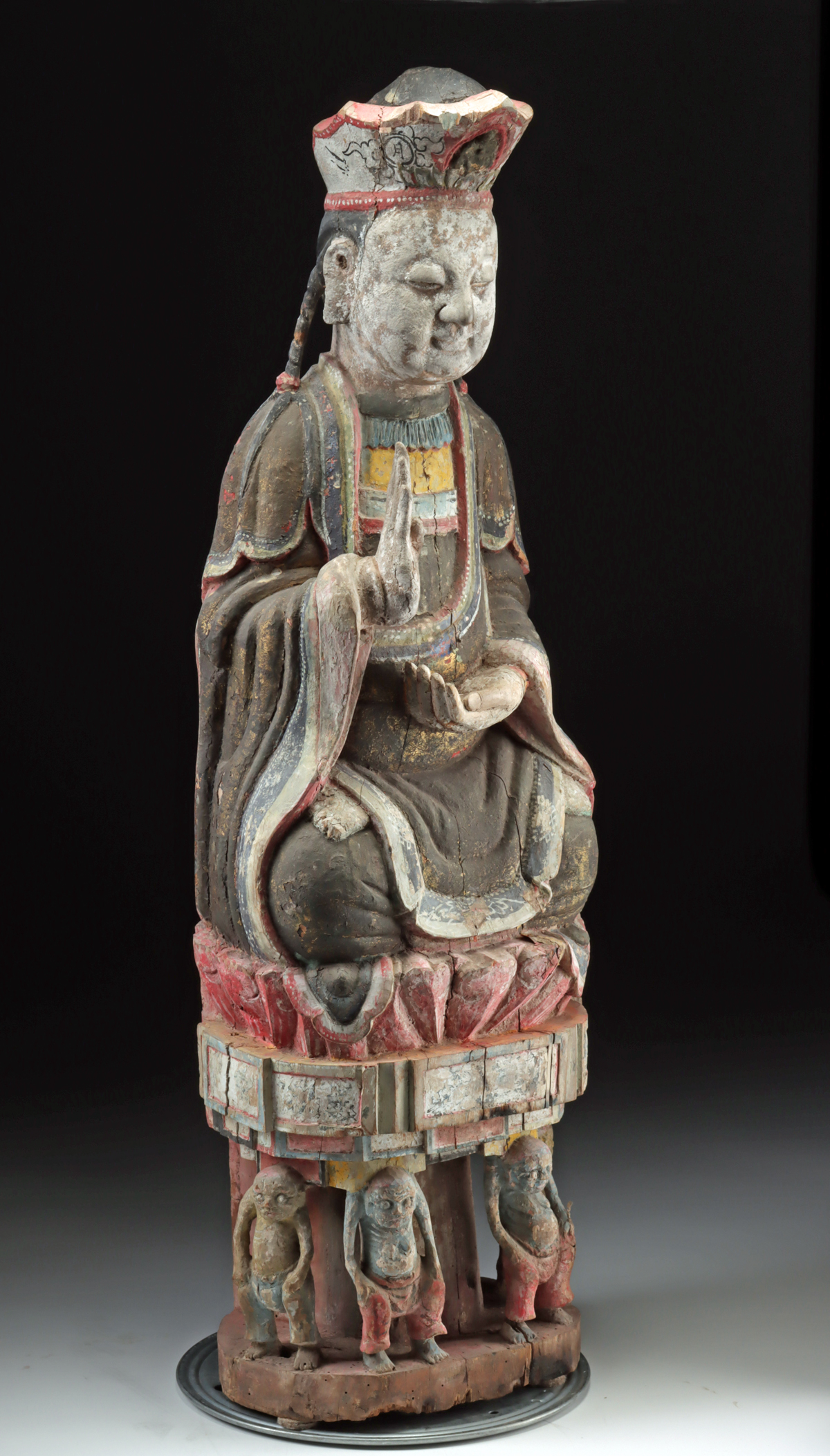
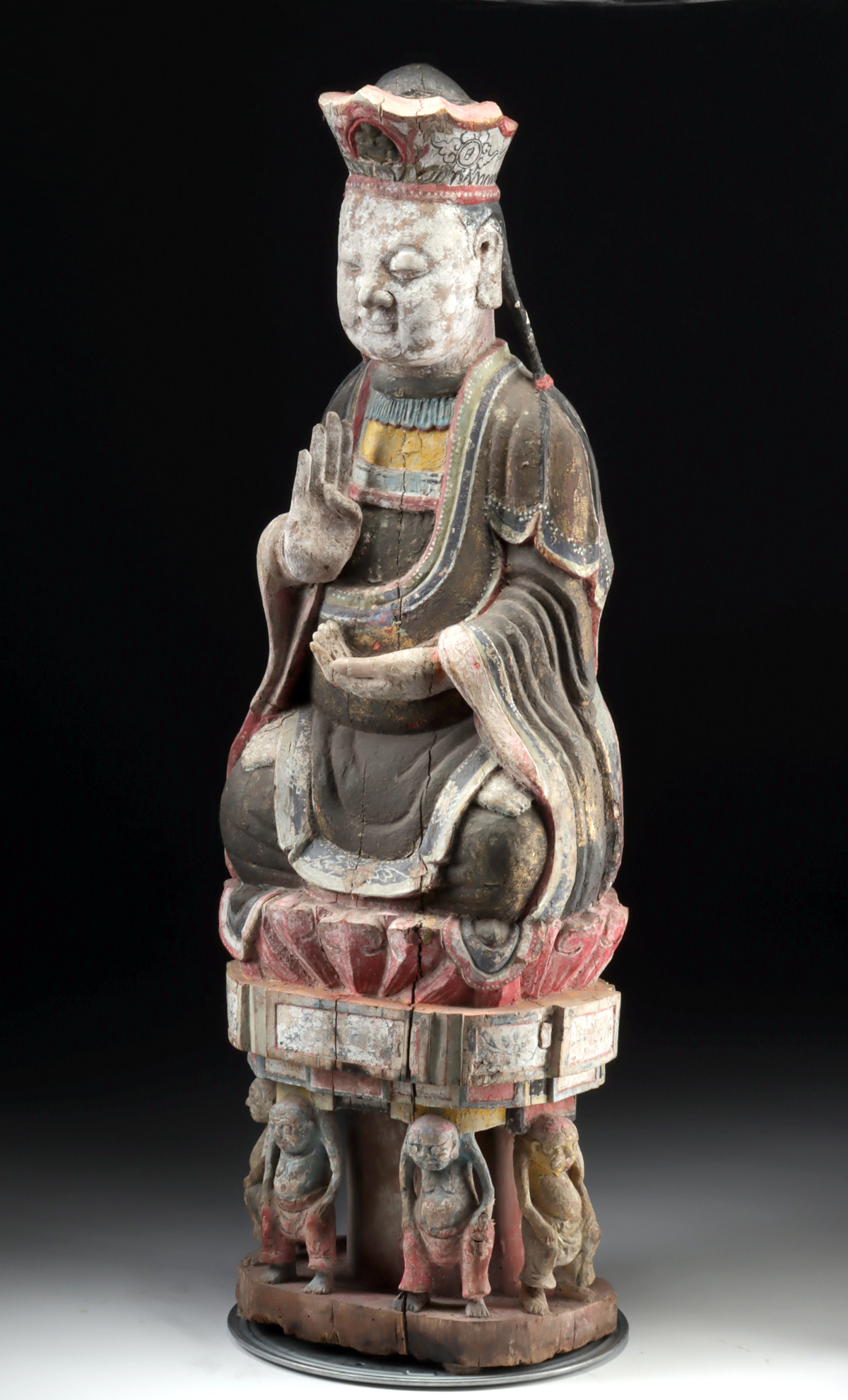
East Asia, China, Qing Dynasty, ca. 18th to 19th century CE. From the heart of the Qing dynasty, a woodcarving of rare and wondrous artistry emerges, a singular testament to the remarkable folk art of that era. It unveils the beloved bodhisattva Guanyin, robed in full majesty, serenely seated upon a lotus that unfurls above a hexagonal throne, her legs gracefully composed in the full lotus posture (padmasana), her feet blossoming upward. Her lotus-shaped eyes are cast down in a serene gaze, and her lips are curved in a slight, benign and contemplative smile. Her long hair is tied up in knots at the back of her head in a chignon, positioned behind a small tripartite diadem that features a stylized Amitabha Buddha in the center. One hand rests in the stillness of dhyana mudra, a silent communion with meditation, while the other ascends in abhaya mudra, a blessing of protection, peace, and the gentle reassurance, “have no fear.” Size: 9.6″ L x 11.5″ W x 37.8″ H (24.4 cm x 29.2 cm x 96 cm)
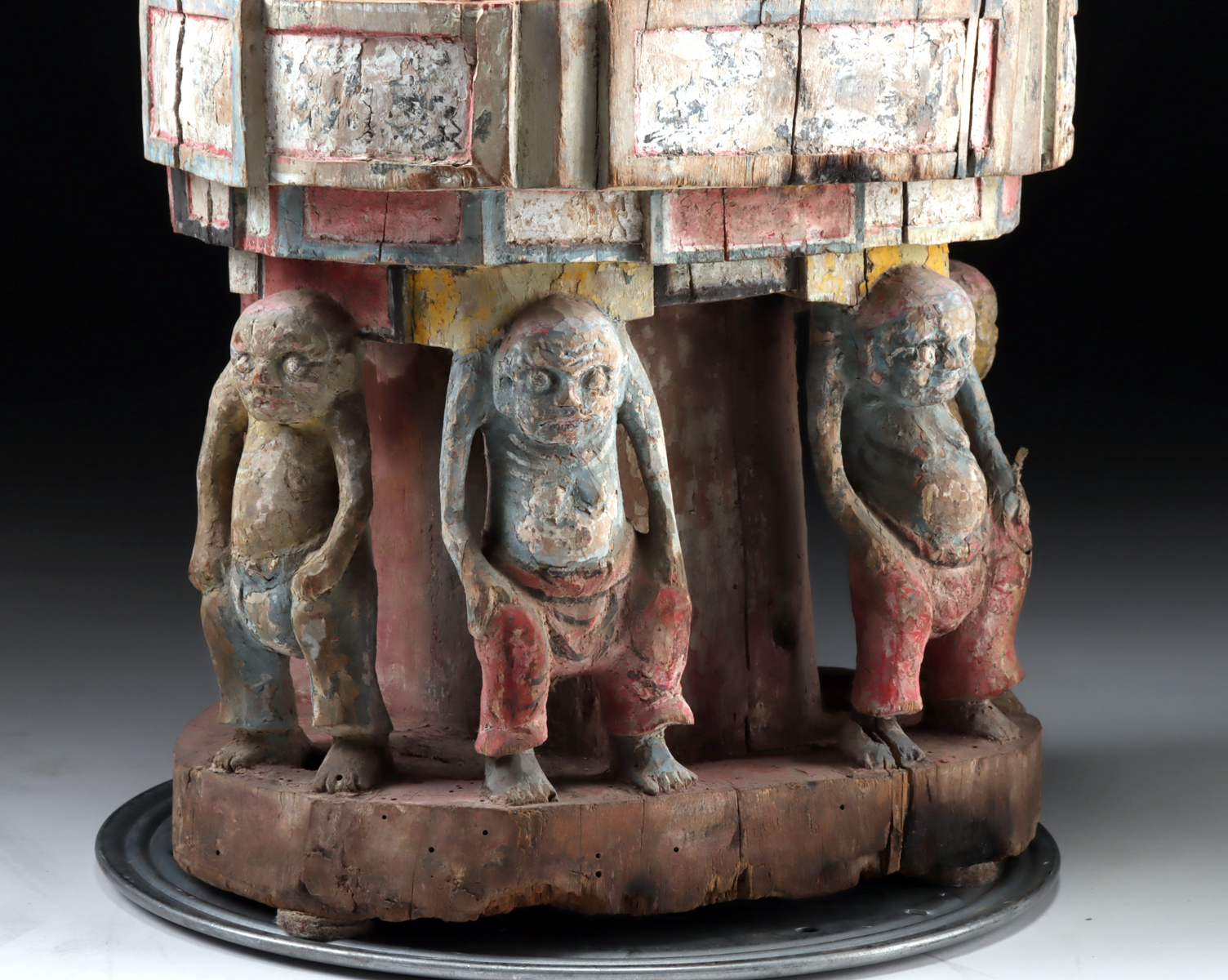
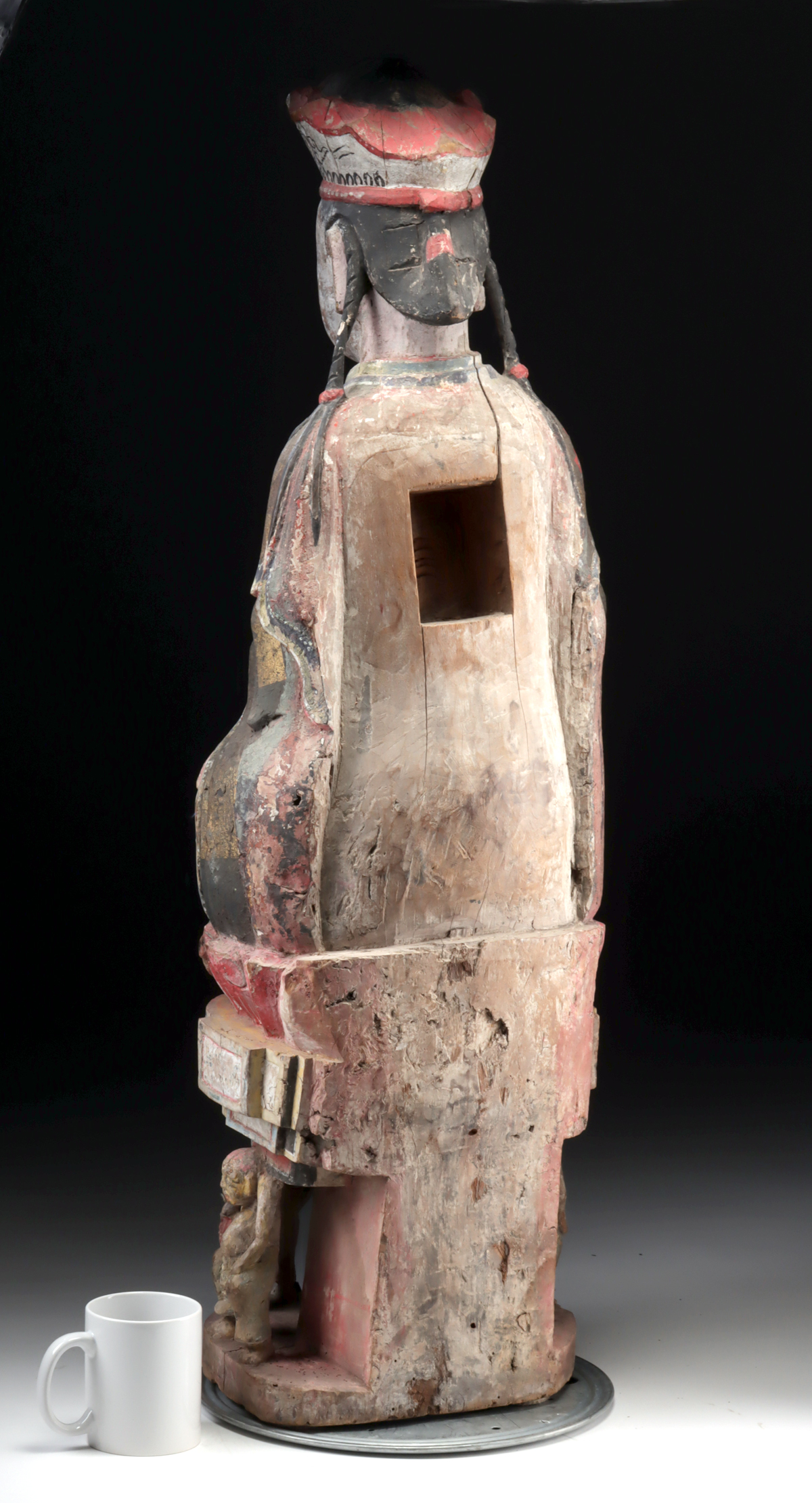
A stout lotus stem, a lifeline of purity, rises from the base, piercing through the throne and reaching towards the heavens. Yet, a startling and unique vision unfolds: four haggard and anguished creatures, burdened by the weight of the throne, struggle to uphold her serene presence. These wretched, grotesque figures can be interpreted as Atlantis figures, representing the forces of ignorance and the enemies of Buddhism, their strained posture highlighting the triumph of Buddhism over these negative forces – a concept that shows the influence of Tibetan Buddhism on Mahayana Buddhism in China, particularly during the Ming Dynasty, a period of religious and political exchange that began with Emperor Yongle (1403-1424) and continued into the Qing. This grand image, likely once enshrined within a humble community sanctuary or a resplendent Guanyin temple, bears an unpainted reverse, a telltale sign of its intended display high against a wall, its form foreshortened for earthly gazes looking upward. Traces of repainting in certain areas are typical of customary temple practices, especially in the provinces, and an empty cavity at its rear hints at a sacred consecration through an eye-opening ceremony. This rural treasure, once veiled from the eyes of Chinese literature and collectors, now emerges into the light, its charming spirit, artistic merits, and inventive designs finally embraced and celebrated.
Far from the imperial court’s dictates during the Ming and Qing Dynasties, China’s rural and provincial landscapes witnessed a flourishing of Guanyin statues, born not of governmental or religious decree, but from the hands of local or itinerant artisans. Unburdened by proscribed artistic rules governing form, proportion, symbolism, and iconography, these often-talented creators drew from their own wellsprings of artistic vision, weaving together a vibrant tapestry of components and symbols. Unaware of the aesthetic conventions championed by imperial authorities, they freely merged Buddhist, Taoist, and popular folk religious traditions. In lieu of the regal bejeweled robes and opulent jewelry adorning imperial Guanyin images, these deities often appeared in modest, simple attire with unpretentious collars and flat ornaments.
The lotus, imbued with profound symbolic weight in Buddhist art, served as a pedestal reserved for Buddhas and Bodhisattvas alone. Rising pristine and beautiful above muddy waters, the lotus embodies purity and rebirth, its self-generation mirroring the human condition and eloquently illustrating the journey toward enlightenment. As for the four grotesque creatures, they represent the monster, demon, or ghost-like beings fulfilling a dual purpose within Buddhism: to inspire virtuous conduct through fear and to illuminate the “monsters within” – our most destructive and flawed aspects. Far from harmful, they underscore the fluid transition from demon to bodhisattva and back, the constant evolutionary flux toward enlightenment, rendering this piece a potent metaphor for our own era. The only known precursors in Asian art for these supporting creatures appear in 10th-century Champa and 12th-century Angkor Thom, where dragons, elephants, or other beasts grace shrine corners, upholding architectural elements, echoing a broader Asian artistic tradition of terrifying visages designed to ward off malevolent spirits.
Historically, carved figural statues held profound cultural and religious significance in China, serving not merely as decoration but as vital conduits for spiritual inspiration, solace, and ancestral veneration. These sacred objects populated homes, clan halls, temples, and public spaces, where altars and shrines honored familial ancestors and a pantheon of deities. The size and opulence of these dedicated spaces reflected a family’s standing, with even modest homes featuring altars for expressing Confucian piety through ancestor worship. Wealthier families often dedicated entire rooms to elaborate shrines, housing images and ancestor tablets – inscribed placards acting as spiritual seats for the deceased, sometimes even found in temple halls where monks offered prayers for their well-being in the afterlife.
Central to imbuing these carvings with spiritual potency was the “eye opening ceremony,” a consecration ritual performed by a senior priest or monk. This process, involving practices like dotting the eyes with cinnabar, pricking them, or anointing them with liquids, was believed to awaken the statue’s senses, enabling it to perceive and respond to devotees’ prayers. Before this ritual, a cavity carved into the statue’s back was filled with sacred documents, a dated paper script honoring the donors and commemorating the event, prayers, and symbolic items representing inner organs, then sealed. The completed, veiled statue was then solemnly carried to the temple for the complex consecration, a communal event believed to imbue the inert carving with life force (chi or qi) and invite the deity’s spirit to reside within.
Condition: Repainting in some areas reflects customary temple practices. Cavity in verso is empty and without cover. Stable fissures and some weathering and abrasions to surface as shown, but, otherwise, excellent with nice pigments and light patina.
Provenance: private Los Angeles, California, USA collection, acquired from 1990 – 2005
All items legal to buy/sell under U.S. Statute covering cultural patrimony Code 2600, CHAPTER 14, and are guaranteed to be as described or your money back.
A Certificate of Authenticity will accompany all purchases.
We ship worldwide and handle all shipping in-house for your convenience.
Related Products
-


Lot 152a, Auction 4/3/2026: Mesopotamian Stone Libation Bowl Lion Effigy
Add to cart -


Lot 150, Auction 4/3/2026: 12th C. Medieval Stone Corbel with Dual Faces
Add to cart -


Lot 135, Auction 4/3/2026: Eastern Greek Archaic Terracotta Votive – Woman w/ Bird
Add to cart -


Lot 130, Auction 4/3/2026: Ancient Egyptian Ptolemaic Pottery Figurine Fragments
Add to cart -


Lot 126, Auction 4/3/2026: Egyptian Painted Wood Hand – Late Dynastic Sarcophagus
Add to cart -


Lot 121, Auction 4/3/2026: Papua New Guinea Bamboo & Vegetal Fiber Implements
Add to cart -


Lot 119, Auction 4/3/2026: Papua New Guinea Yimam Yipwon Spirit Figure – Korewori
Add to cart -


Lot 117, Auction 4/3/2026: Dayak Wood Bound Captive Figure w/ Horse Hair Rope
Add to cart -


Lot 116, Auction 4/3/2026: Borneo Dayak Wood Ancestral Figure, Hampatong Guardian
Add to cart -


Lot 112, Auction 4/3/2026: Two African Wood Nude Figures – Bembe & Chamba
Add to cart