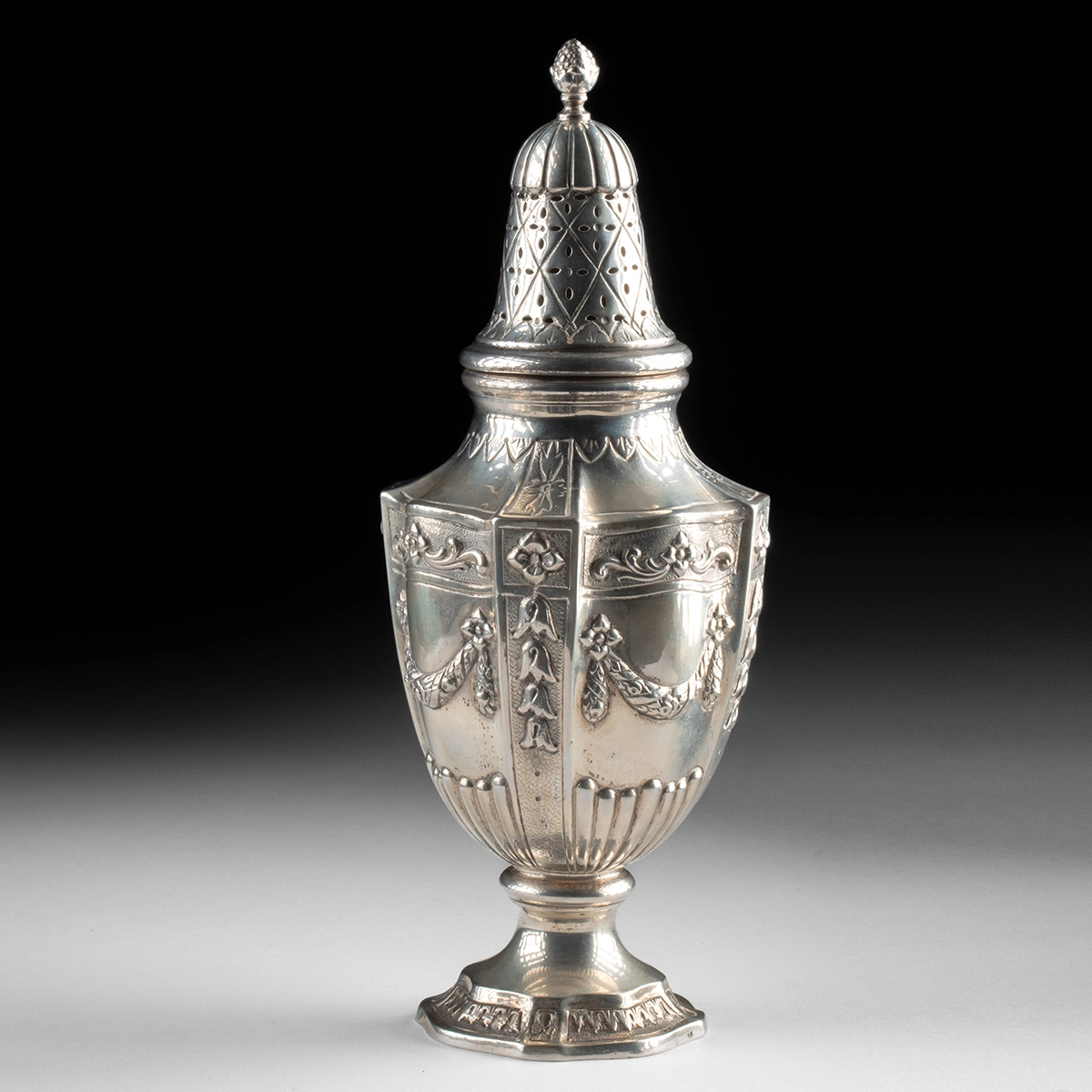



Late 19th/Early 20th C. British Silver Muffineers – Hamilton & Inches and William Neale (Auction 2026-06-05, Lot 264)
$642.50
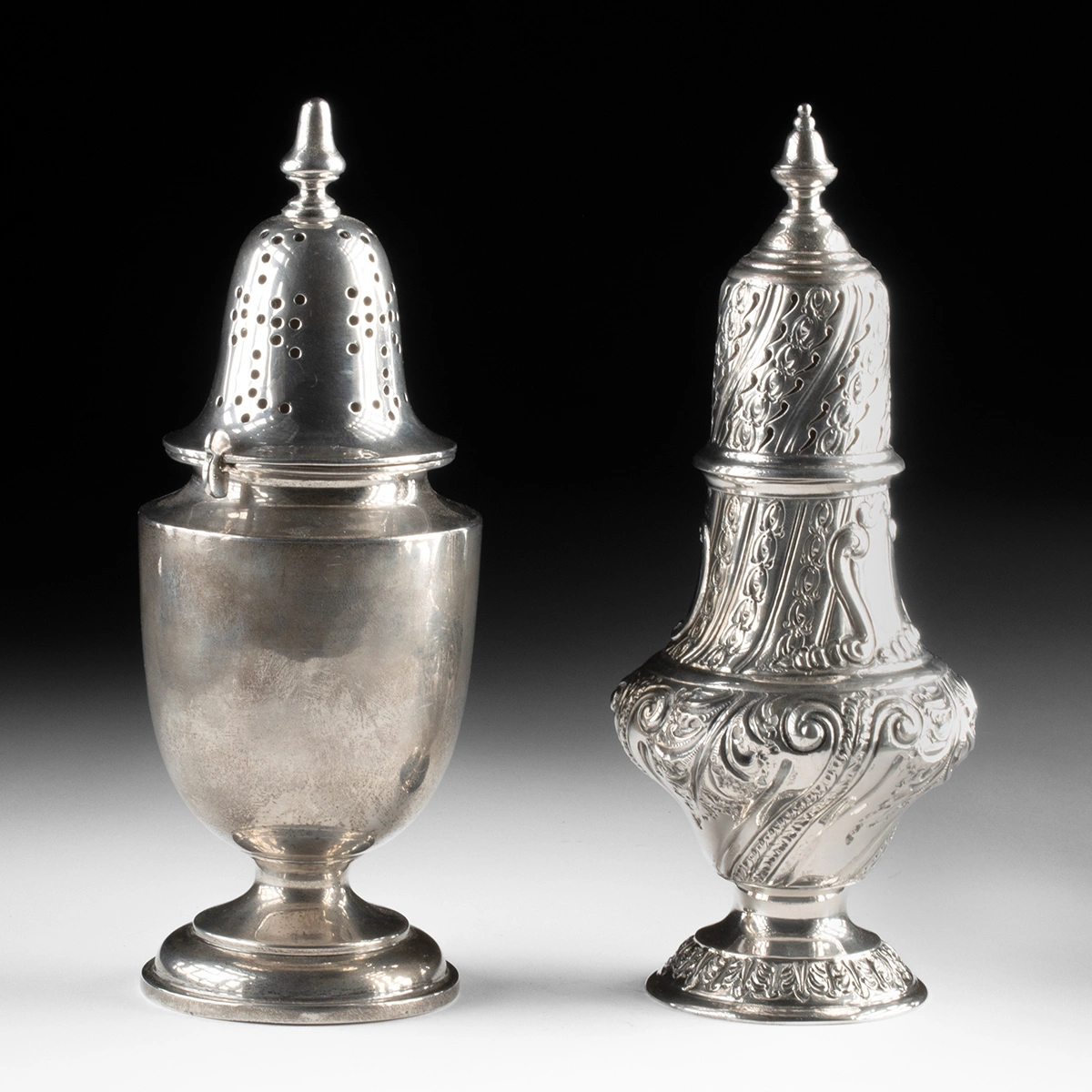
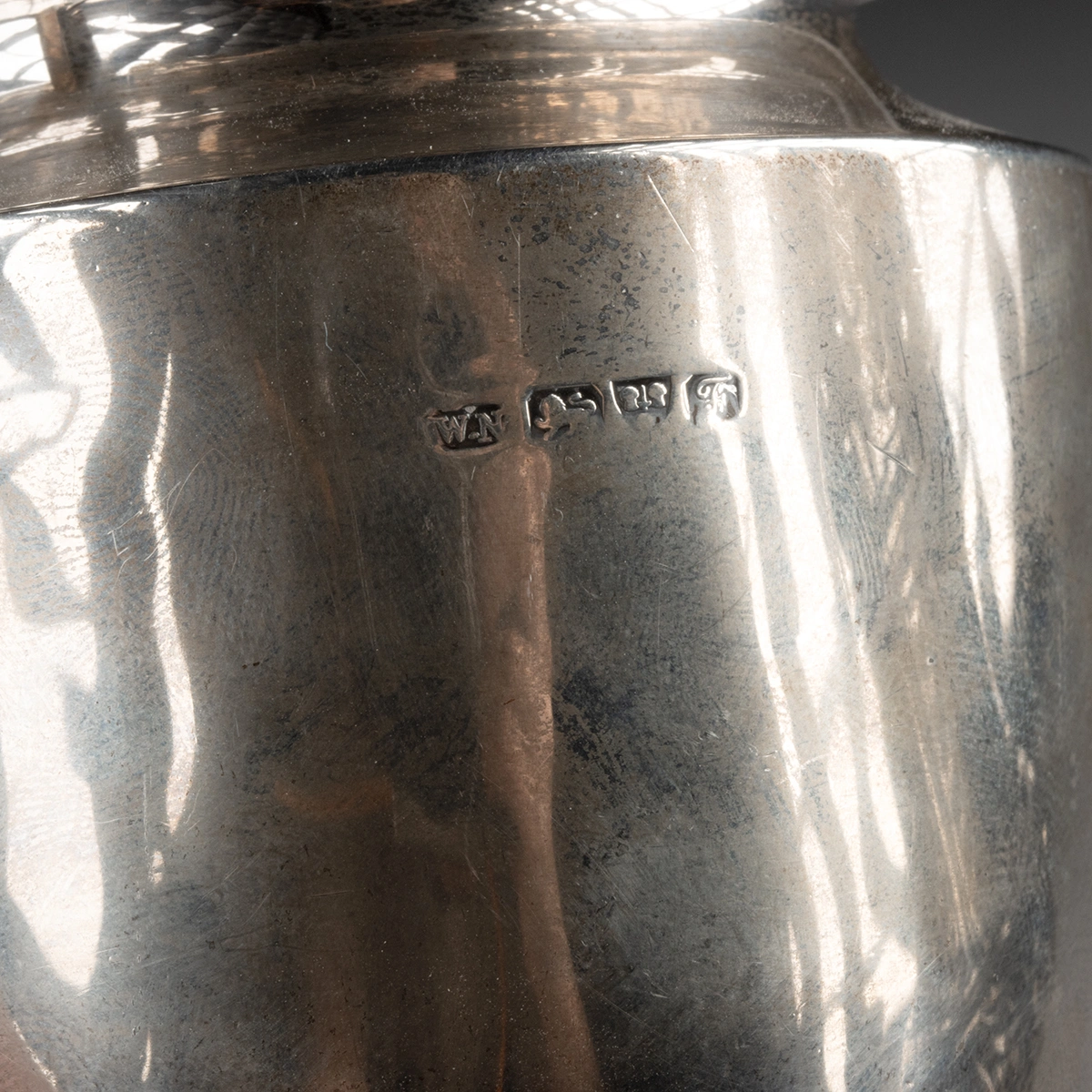
A pair of British sterling silver muffineers, two casters of contrasting temperament caught in the same conversation about the breakfast table. The more elaborate of the pair, struck in Edinburgh in 1890 by the celebrated firm of Hamilton & Inches, rises in a baluster of swirling Rococo Revival exuberance: gadrooned flutes spiral up the body, framed by tight scrollwork, foliate cartouches, and a ring of acanthus at the foot. Its domed cover, pierced for the dusting of sugar or spice, continues the twisting fluted rhythm and terminates in a turned baluster finial. An incised monogram, “JRS,” graces one cartouche, hinting at a Victorian owner whose name has since slipped quietly out of the record. The hallmarks (a castle for Edinburgh, a thistle for Scottish sterling standard, the date letter “i” within a circle for 1890, and the “H&I” maker’s punch) are crisply struck on the base and lid rim. Tested at 94.9 percent silver, the caster sits comfortably above the sterling threshold. Its companion, more restrained and architectural in mood, was assayed in Chester in 1906 and bears the mark of William Neale & Sons. The form is a clean Neoclassical urn on a stepped circular foot, swelling gently to a high shoulder before yielding to a tall, slightly flaring domed cover with a delicate baluster finial. The pierced lid is pinned to the body by twin scroll lugs, a typical Edwardian conceit recalling earlier Georgian prototypes. Hallmarks (three stacked wheatsheaves and a sword in a shaped shield for Chester, the lion passant for English sterling, an uppercase date letter “F” for 1906, and “WN” for William Neale & Sons) appear beneath the shoulder and on the lid rim. Assay returns 92.53 percent silver, again squarely within sterling specification. Muffineers, sometimes called sugar casters or dredgers, perched on the dining tables of the late Georgian, Victorian, and Edwardian periods, dispensing sugar, cinnamon, or pepper over hot muffins, toast, and savories. Together these two trace a generation of taste: the Scottish caster luxuriating in High Victorian ornament, the English one settling into the cooler classical revivalism that would carry silver design into the new century.
Provenance: private Loveland, Colorado, USA collection, acquired in October 1989 via Donald S. Bethune Antiques, Montreal, Quebec, Canada
Condition: Excellent. Some light surface wear, but, otherwise, both are intact and excellent.
Related Products
-


Victorian Coral Graduated Bead Necklace with Brass Clasp (Auction 2026-06-05, Lot 265A)
Add to cart -


Two Late 19th C. International Stamp Albums (Auction 2026-06-05, Lot 271)
Add to cart -


Stamps & Air Mail – British Colonies, Oceania, & US (Auction 2026-06-05, Lot 271C)
Add to cart -


Signed First Edition “The Vortex” by Noel Coward (1925) (Auction 2026-06-05, Lot 270)
Add to cart -


Pair WWI Trench Art Brass Shell Vases 1919 (Auction 2026-06-05, Lot 267)
Add to cart -
Late 19th C. German 800 Silver Muffineer – Neoclassical Revival Sugar Caster (Auction 2026-06-05, Lot 263)
Add to cart -


Large Italian Deruta Maiolica Tureen & Gravy Boat (Auction 2026-06-05, Lot 267A)
Add to cart -
Ecuadorian Macana Shawl – Indigo Ikat & Fleco (Auction 2026-06-05, Lot 241)
Add to cart -


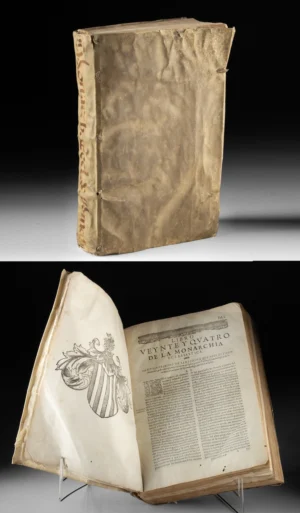
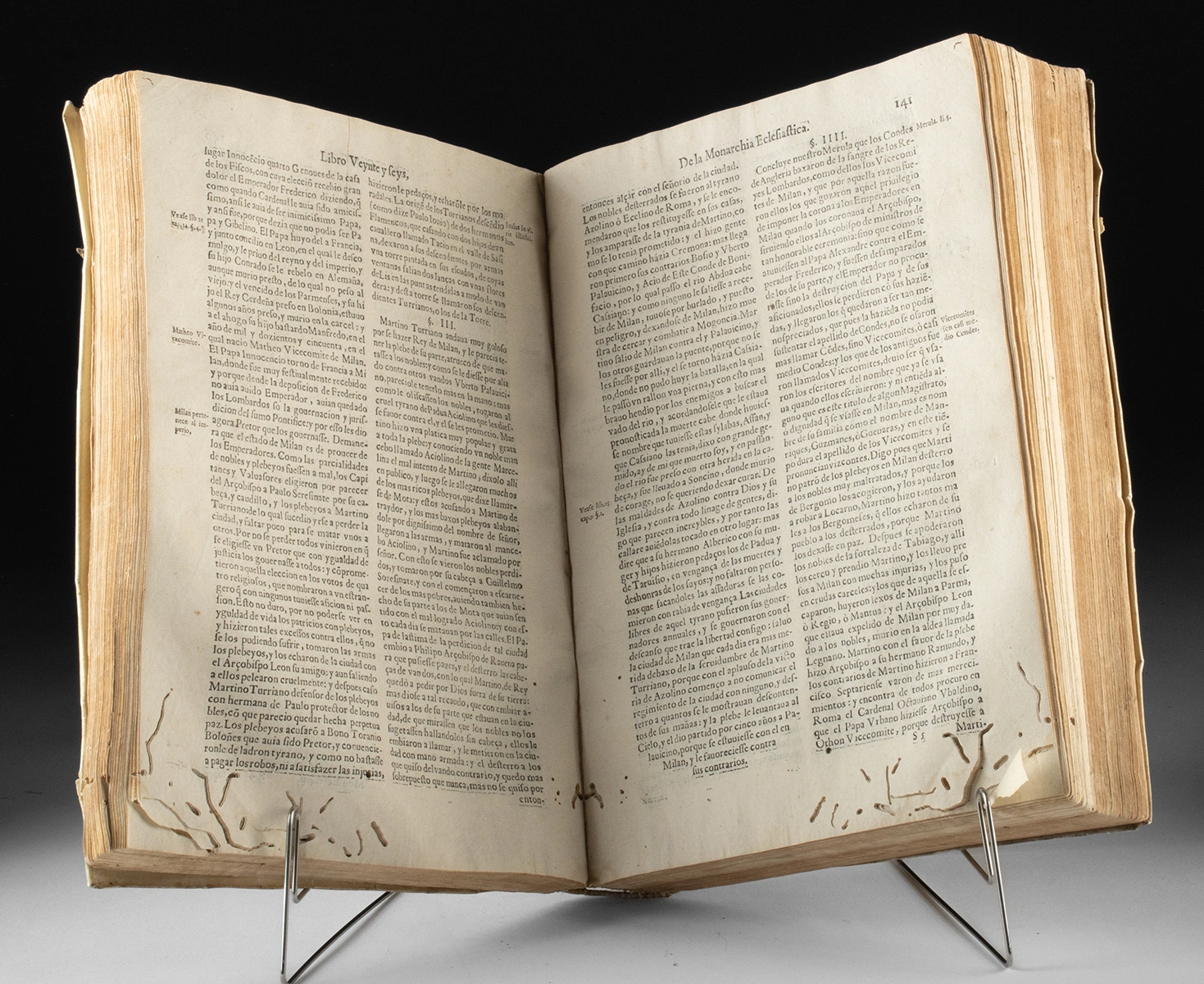
1st Ed. “Monarchia Ecclesiastica” 1620 – Juan de Pineda (Auction 2026-06-05, Lot 268)
Add to cart -


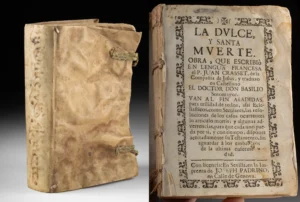
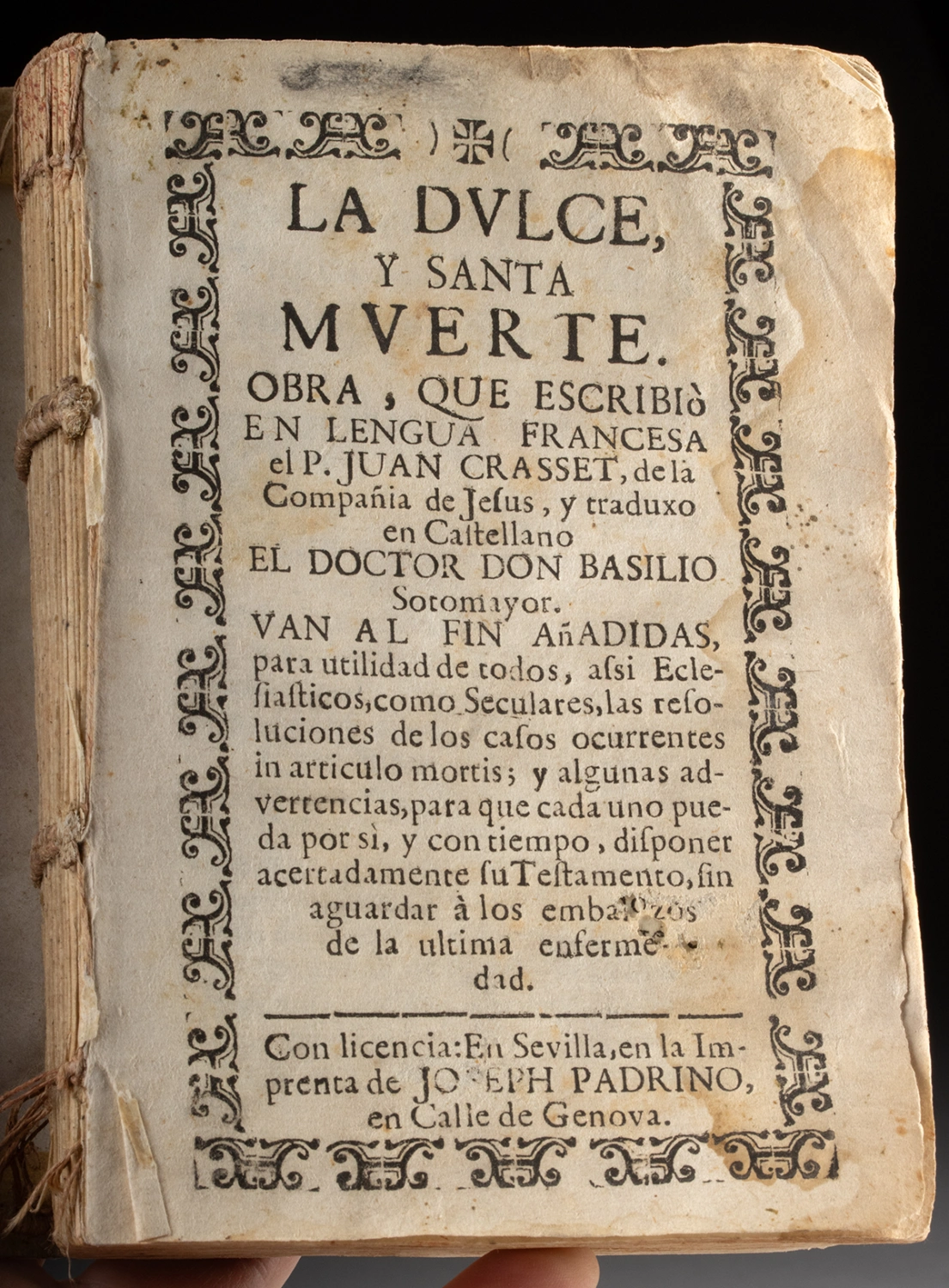
“La Dulce y Santa Muerte” Spanish Devotional Book, 1750 (Auction 2026-06-05, Lot 269)
Add to cart