Exhibited Song Jizhou Leaf Decorated Bowl – TL’d
$19,995.00
In stock
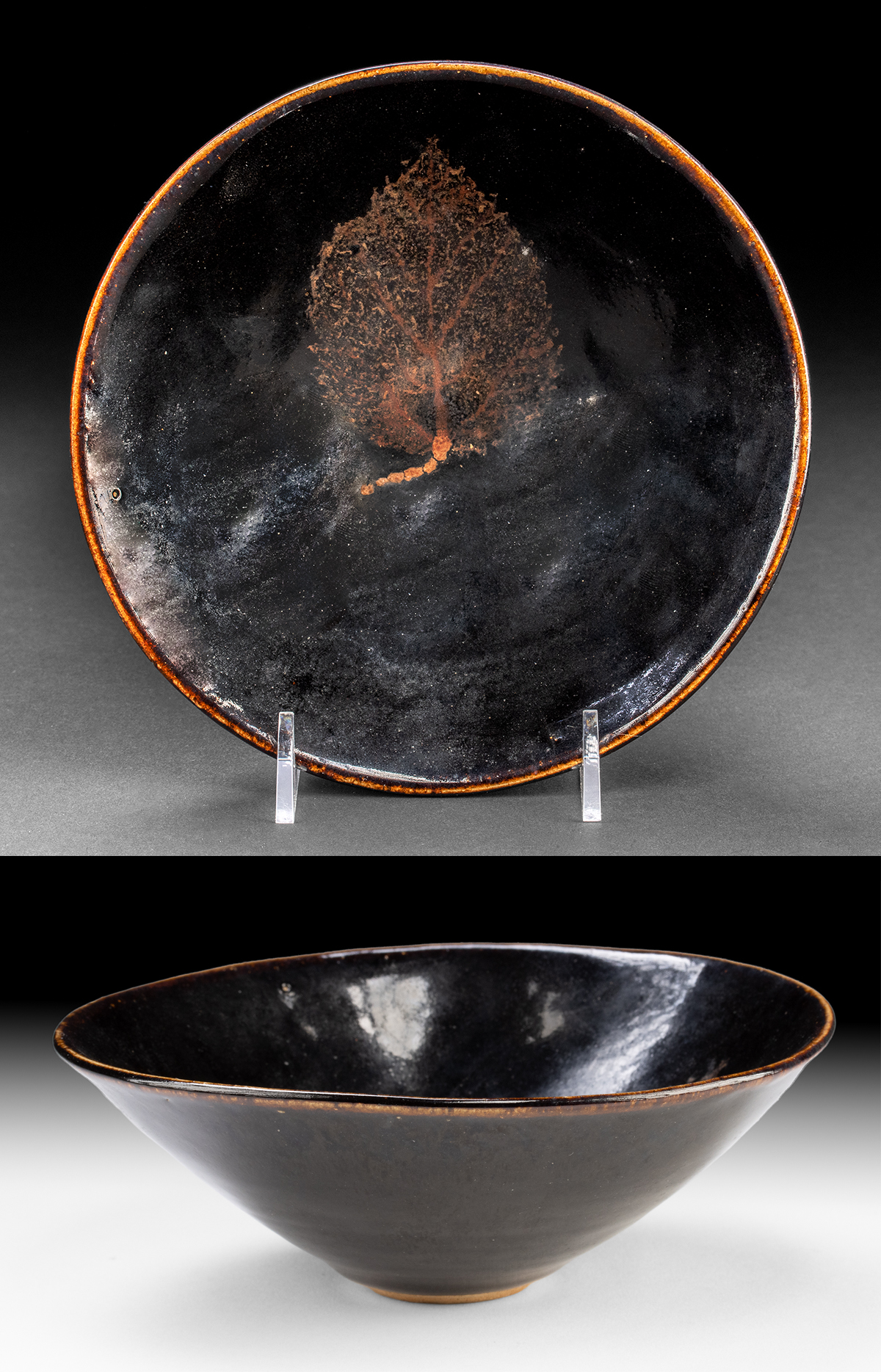
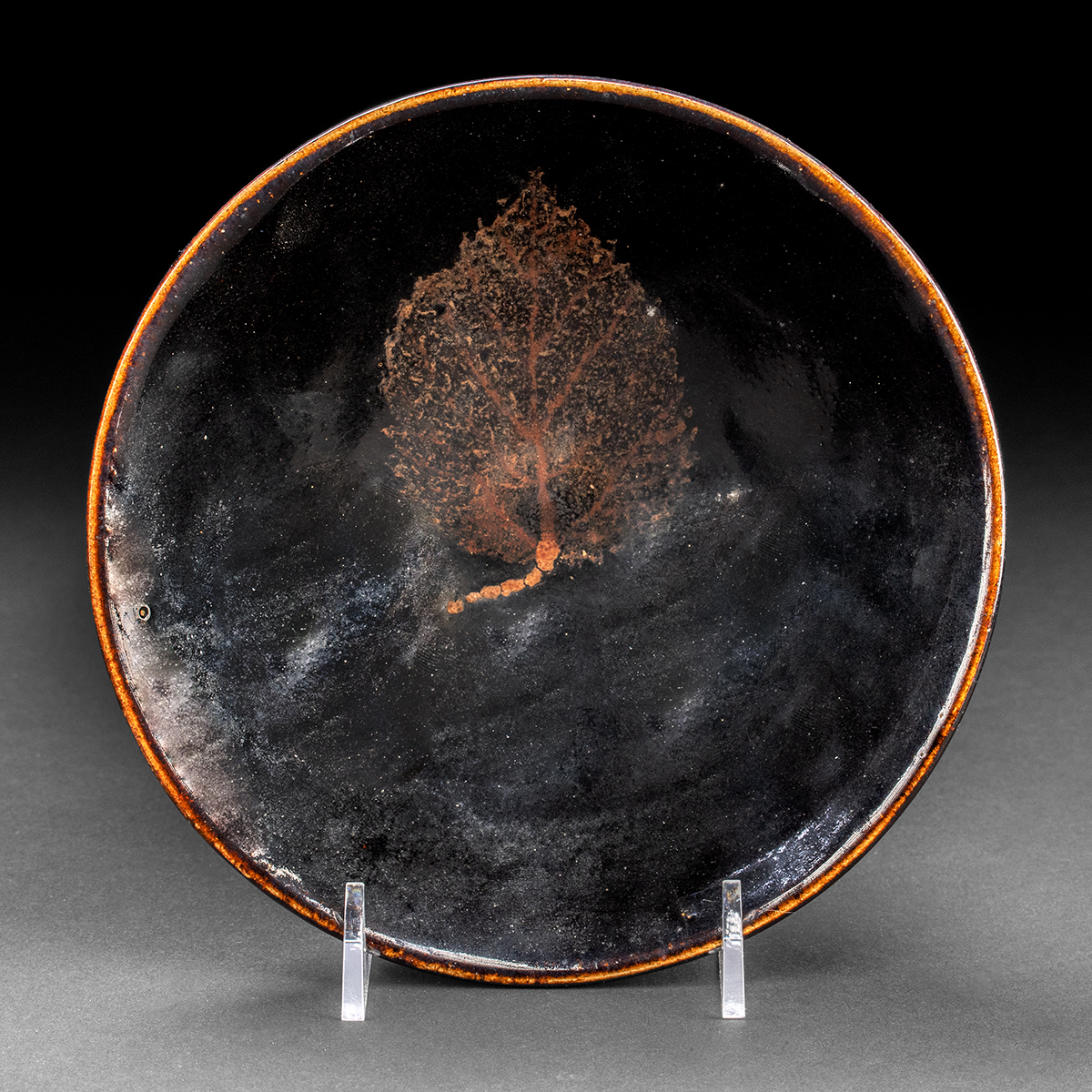
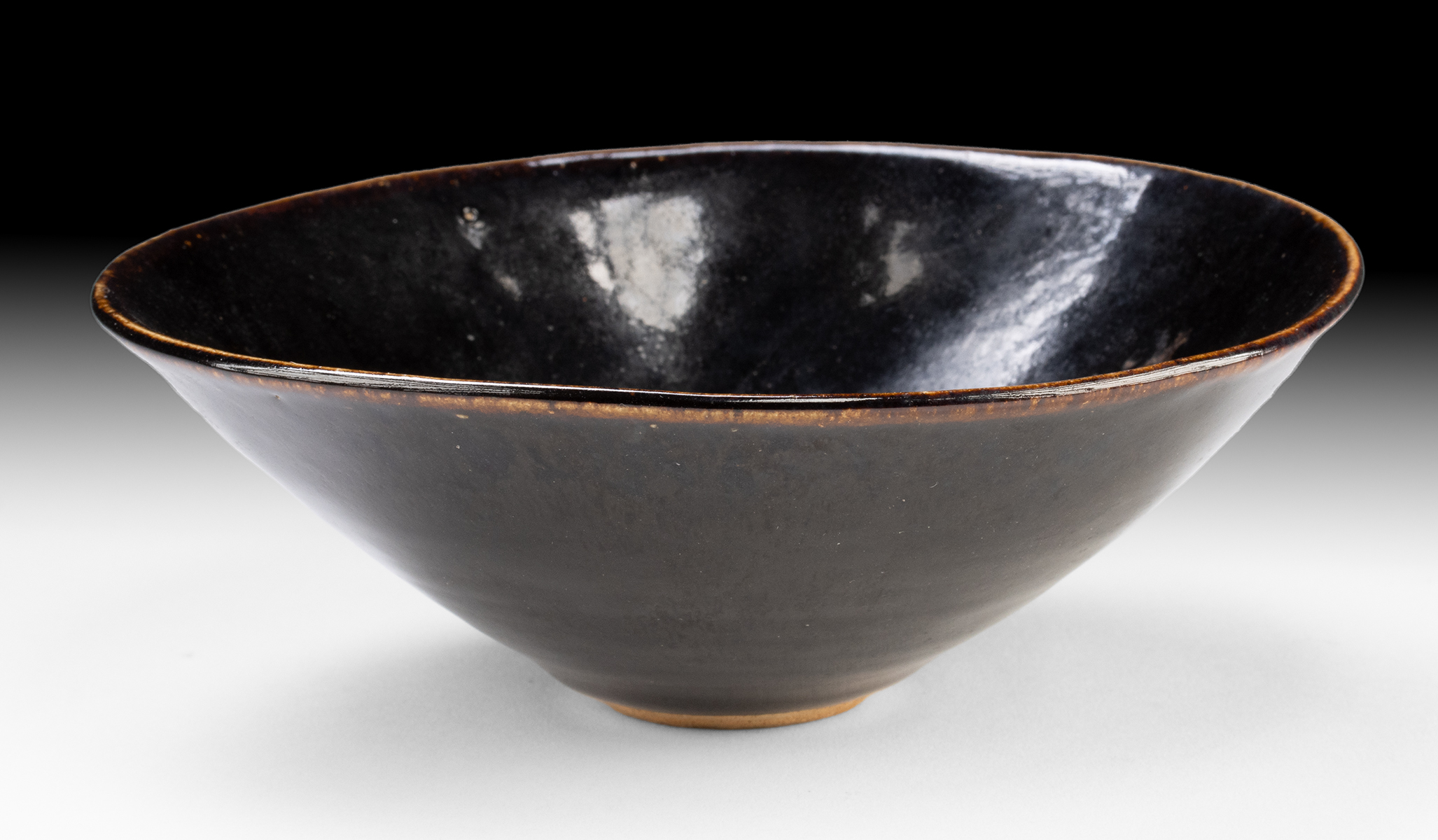
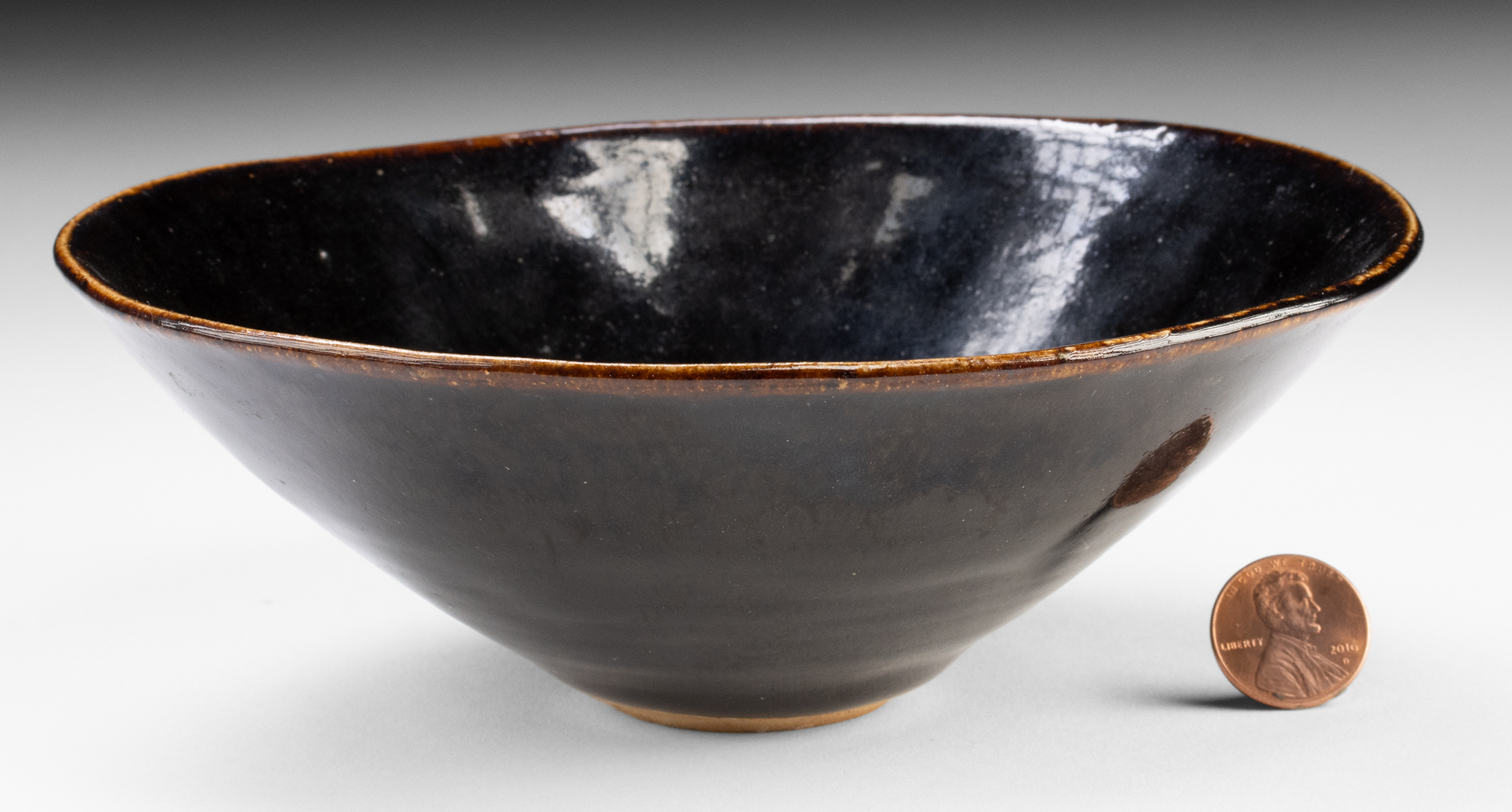
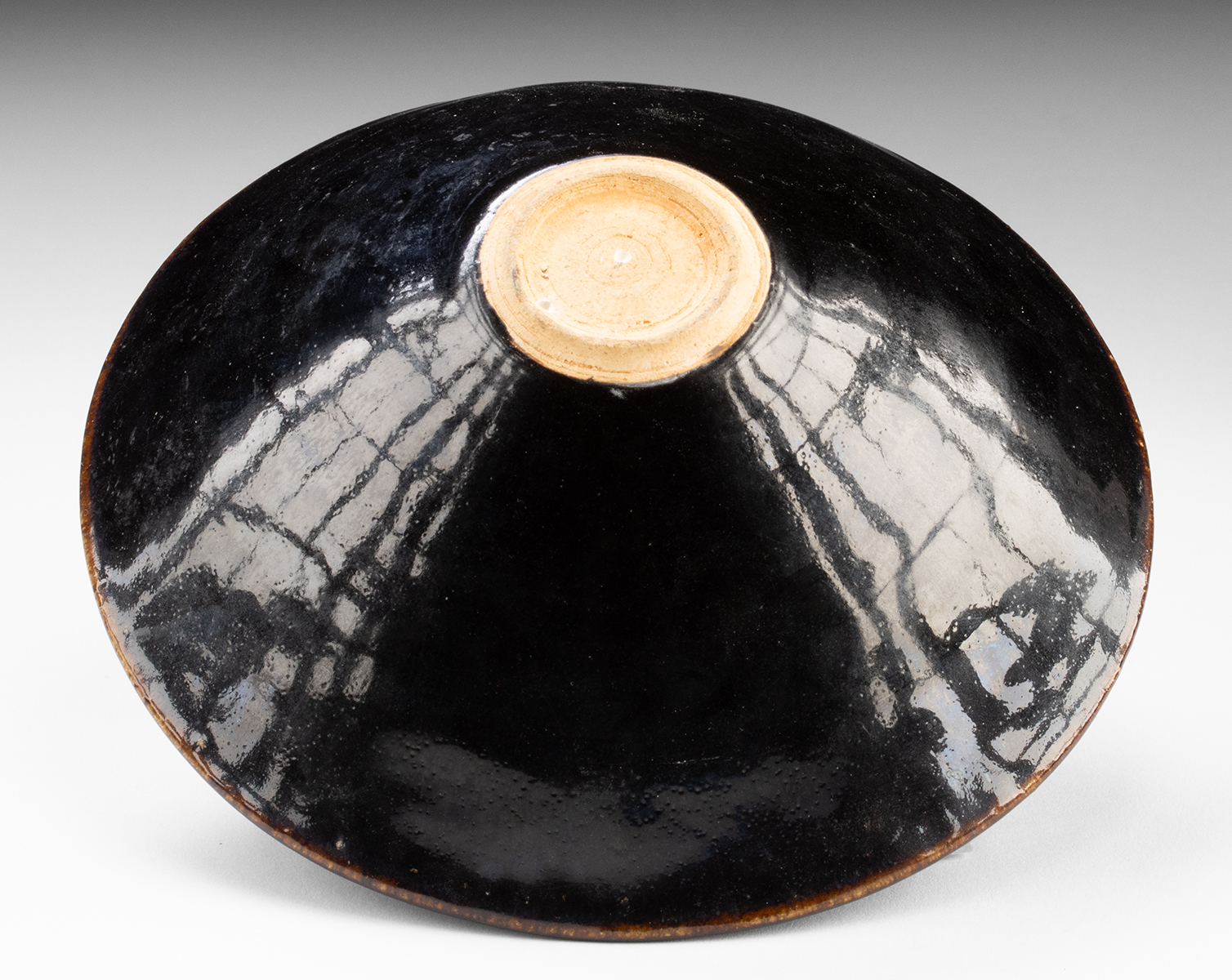
East Asia, China, Southern Song Dynasty, ca. 1127 to 1279 CE. A rare and quietly astonishing Jizhou conical tea bowl, its dark glaze holding the spectral trace of a single leaf, preserved like a breath caught in lacquered night. Delicately potted with wide, flaring sides, the bowl rises with an elegant tension between weight and lightness, its form among the most revered in the Jizhou leaf tradition. The interior is centered with the gossamer imprint of a brownish-buff leaf, floating against a deep, lustrous brown glaze that thins gracefully to amber at the rim. The glaze falls short of the shallow ring foot, revealing the warm buff body beneath. This chromatic transition, from darkness to translucence, heightens the sense of depth and draws the eye inward, toward the fragile botanical silhouette at the heart of the vessel. Size: 6.3″ Diameter x 2.3″ H (16 cm x 5.8 cm)
Leaf decoration represents the most daring and conceptually refined achievement of the Jizhou kilns. As discussed by Robert Mowry, the effect was achieved by affixing an actual leaf to the interior of the bowl before immersing it in glaze. During firing, chemical reactions rendered the leaf transparent, burning away its substance while preserving its structure. The result is a ghostly image, often golden amber or pale yellow, a negative space made visible by fire. Because leaf edges frequently curled or burned away in the kiln, complete impressions are uncommon. The clarity and balance of the present example mark it as a notably successful and rare execution.
Beyond technical bravura, the leaf motif carries philosophical weight. The act of fixing a perishable leaf onto an enduring ceramic form resonates deeply with Zen Buddhist ideas of impermanence, presence, and quiet observation. Jiangxi province, home to the Jizhou kilns, was a major center of Zen Buddhism during the Song dynasty, with more than fifty monasteries active at the time. Tea culture and Zen practice were inseparable, and bowls such as this were integral to both ritual and contemplation.
During the Kamakura period, Japanese Zen monks carried these bowls back to Japan, where they became revered as Konoha Tenmoku, or leaf Tenmoku. Conical examples such as this are considered the most prestigious form. A closely related bowl, designated an Important Cultural Property, resides in the Museum of Oriental Ceramics, Osaka. Comparable examples are held in the National Palace Museum, Taipei, the Museum of Fine Arts, Boston, and other major institutional collections, underscoring the rarity and significance of this type.
At once technically audacious and philosophically restrained, this Jizhou leaf bowl captures a fleeting natural moment and asks it to endure. Fire, clay, and chance conspire here with remarkable precision, leaving behind a vessel that is both meditation object and masterpiece.
A very similar porcelain bowl hammered 937,500 HKD (now equivalent to $165,691.92) at Christie’s Hong Kong on December 2nd, 2015 (Live Auction 3474, lot 2818).
This piece was exhibited at Rollins Museum of Art (formerly The George D. and Hariet W. Cornell Fine Arts Museum) at Rollins College, Winter Park, Florida, USA as part of “Treasures of the Chinese Nobility: The Chauncey P. Lowe Collection” from May 31st to September 14th, 1997.
This piece has been tested using thermoluminescence (TL) analysis and has been found to be ancient and of the period stated. A full printed and bound report will accompany the item upon purchase.
Condition: A few miniscule nicks and a tiny flea bite on interior near rim, but, otherwise, bowl is intact and excellent with impressive preservation of gossamer decoration. Two TL holes to underside of base.
Provenance: private Orlando, Florida, USA collection, acquired in Southern Florida, USA, 1993 – 1997, collection exhibited at Rollins Museum of Art (formerly Cornell Fine Arts Museum) at Rollins College, Winter Park, Florida, USA, in 1997
All items legal to buy/sell under U.S. Statute covering cultural patrimony Code 2600, CHAPTER 14, and are guaranteed to be as described or your money back.
A Certificate of Authenticity will accompany all purchases.
We ship worldwide and handle all shipping in-house for your convenience.
Related Products
-


Lot 174, Auction 4/3/2026: 8 Chinese Pipe Bowls, Pottery, Stone, Brass & Wood
Add to cart -


Lot 171, Auction 4/3/2026: Four 18th C. Chinese Qing Stone & Glass Snuff Bottles
Add to cart -


Lot 170a, Auction 4/3/2026: 2 Yuan & Ming Celadon Bowls – Twin Fish & Lotus Motifs
Add to cart -


Lot 163a, Auction 4/3/2026: 18th C. Chinese Qing Blue Splashed Pottery Vessel
Add to cart -


Lot 158b, Auction 4/3/2026: Huge Gandharan Pottery Zoomorph Jar, TL Tested
Add to cart -

Lot 155, Auction 4/3/2026: Three Iron Age to Roman Holyland Pottery Pitchers
Add to cart -


Lot 153, Auction 4/3/2026: Five Holy Land Bronze to Iron Age Pottery Jars & Ewers
Add to cart -


Lot 143a, Auction 4/3/2026: 12th C. Byzantine Pottery Bowl – Sgraffito Bird Design
Add to cart -


Lot 128a, Auction 4/3/2026: Egyptian Early Dynastic Alabaster Cylindrical Jar
Add to cart -


Lot 124, Auction 4/3/2026: Hawaiian Koa Wood Vessels & Salt Shakers, 6 pcs
Add to cart